
How Much Mulch Do You Need? A Morris Township, NJ Guide
April 17, 2025
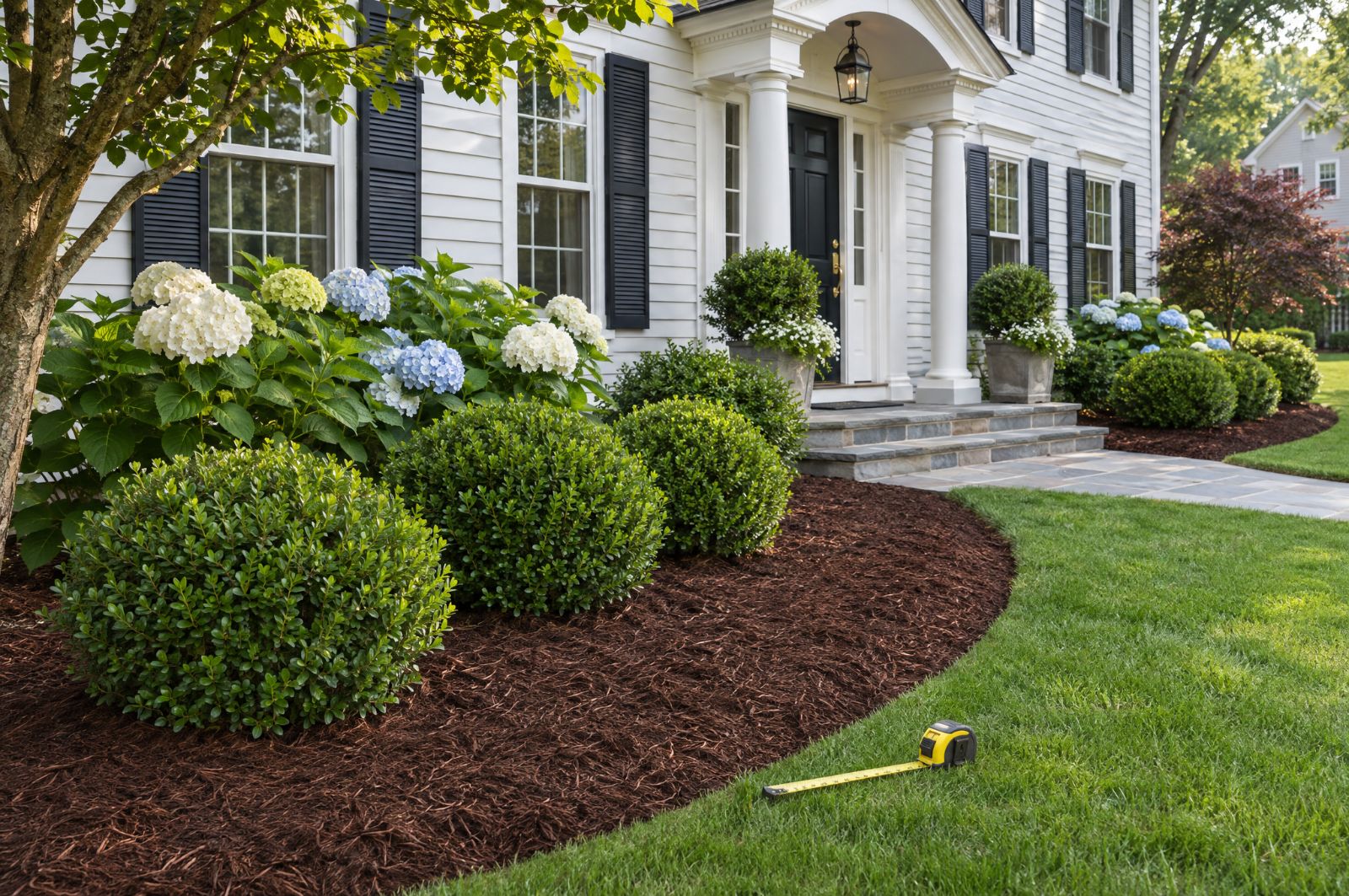
Every spring, Morris Township homeowners ask the same question before the first bed gets touched: how much mulch do I actually need? Guess low and you end up with thin, patchy beds. Guess high and you are left with a pile on the driveway that nobody wants. A few minutes with a tape measure and some simple math will get you close.
Step 1: Measure every bed you plan to cover
Walk the property and list each area: foundation beds, the island around the mailbox, tree rings, the strip along the driveway. Measure each one separately, because adding them up at the end is far more accurate than estimating the whole yard at once.
- Rectangles and strips: length times width gives square feet.
- Tree rings and round beds: measure across the middle, halve it to get the radius, then multiply the radius by itself and by 3.14.
- Curvy or odd beds: break them into a few rough rectangles and add them together. Close is good enough.
Write the numbers down as you go. Most front yards in older Morris Township neighborhoods have more bed space than people expect once the side yards and back plantings are counted.
Step 2: Turn square feet into cubic yards
Mulch is usually sold by the cubic yard when it is not in bags. One cubic yard covers about 324 square feet at a depth of one inch. From there the math is easy:
- At 2 inches deep, one yard covers roughly 160 square feet.
- At 3 inches deep, one yard covers roughly 108 square feet.
Here is a worked example. Say your beds add up to 540 square feet and you want a 2 inch layer. Multiply 540 by 2 to get 1,080, then divide by 324. That comes to about 3.3 cubic yards. Rounding up a little to cover uneven spots is sensible, but rounding up a lot just leaves you with extra.
If you are comparing against bagged mulch, a typical 2 cubic foot bag is a small fraction of a yard. It takes roughly 13 or 14 of those bags to equal one cubic yard, which is why bags add up quickly on larger properties.
Step 3: Pick the right depth for each bed
Depth is where most people go wrong, and it changes the total more than anything else.
- New or bare beds: 2 to 3 inches is the standard range. That is enough to block light from weed seeds and hold moisture.
- Beds that already have mulch: if there is still an inch or two left from last year, a 1 inch top-up usually restores the color and coverage.
- Around trees and shrubs: keep the mulch pulled a few inches away from trunks and stems. Mulch piled against bark, the so-called volcano, holds moisture against the wood and invites rot and pests.
Before you order, poke a finger or trowel into last year’s mulch. Many beds need far less than a full new layer, and skipping the extra depth saves money and protects the plants.
Why the number often comes out wrong
Even careful homeowners miss the mark. The most common reasons:
- Forgetting the side yard and back beds when measuring.
- Applying a full 3 inches on top of beds that already have plenty.
- Not accounting for slopes, where mulch tends to wash down and needs a bit more at the top.
- Estimating by eye instead of measuring each bed.
When it is easier to hand the job off
Measuring is the easy part. Edging the beds, pulling weeds, raking out old matted mulch and then wheelbarrowing several yards across the lawn is what eats a weekend. Boris’s mulch delivery and spreading service takes care of the measuring and the work, and the beds can be weeded and edged first through landscape bed maintenance so the fresh layer goes down clean. Boris serves Morris Township and the rest of Morris County, and he talks with you directly about how your beds should look.
If you would rather not think about it every year, a property maintenance plan can include mulching on a regular schedule along with the rest of your yard care.
Mulch quantity questions
Do I need to remove old mulch before adding more?
Not always. If the old layer is thin and loose, you can top it up. If it is thick, matted or crusted, rake it up or loosen it first so water can get through.
Is it better to round up or down?
Round up slightly, by a fraction of a yard, to cover uneven areas. A large surplus is hard to store and often goes to waste.
How often do beds need fresh mulch?
Most beds look best with a light refresh once a year. Shaded beds that break down slowly can sometimes go longer.
Let Boris handle your mulch this season
Skip the math and the wheelbarrow. Boris will look at your Morris Township beds, recommend the right depth and spread it neatly.